
I’ve lost a tooth and my dentist is suggesting a Maryland Bridge. I thought dental implants were the best treatment to replace a tooth. Plus, it’s older than a Maryland Bridge. How does something become the standard of care in dentistry?
Grace
Dear Grace,
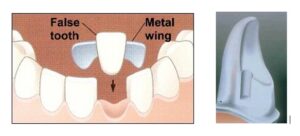
First, you are correct, a dental implant is the best tooth replacement option, not because it has been around longer, but because it is the closest thing to having a healthy, natural tooth in your jaw again. Did your dentist give you a reason as to why you couldn’t get an implant? If not, I would ask him before planning your treatment.
If it is not possible, then a Maryland Bridge is a fantastic option because it gives you a solid tooth replacement without having to remove a lot of healthy tooth structure. To answer your question about standard of care, though, let’s look at the Maryland Bridge as an example.
We don’t determine standard of care by longevity. For instance, dentures have been around longer than implants, but a dentist would not be likely to suggest dentures unless no other option works for the patient. Nearly every treatment we use today—from tooth-colored fillings to dental implants—had to be tested, refined, and improved over time.
With a traditional bridge, you have to have a dental crown placed on the two adjacent teeth. This is fine if those teeth need a crown, but if they don’t you may not want to grind down healthy tooth structure. Another dentist considered this problem and the start of today’s Maryland Bridge is the result.
It replaces a missing tooth by bonding a replacement tooth to the backs of the neighboring teeth. Because it requires very little preparation, it is a fantastic conservative treatment option for some patients.
Where Did We Get a Maryland Bridge?
Most dentists learned that this restoration came from research done at the University of Maryland. However, that isn’t the whole story.
Dr. Stewart R. Halbauer of Cincinnati, developed the original concept years before researchers at the University of Maryland refined and popularized the technique. You can read what Dr. Halbauer’s son, Stewart “Chip” Halbauer II, has to say about this here.
If you looked this up, many websites, and some AI-generated content summaries, continue repeating the traditional explanation. But, the internet doesn’t always have the entire picture. It would be great if history eventually credits the original innovator along with the universities refinement. Either way, the story illustrates an important point: advances in dentistry often occur because one clinician develops an idea and others continue improving it through research and clinical experience.
A dentist’s treatment recommendations should be based on current clinical evidence, proven techniques, and your individual needs, not just “what has always been done” and around the longest. Some patients may benefit from a Maryland bridge, while others may achieve a better outcome with a dental implant or even another restorative option.
Every smile is different, which is why understanding all of your treatment choices is one of the most important parts of your dental care. Your dentist is ethically obligated to give you all of your options.
This blog is brought to you by a friendly dentist in Lexington, Dr. James E. Williams.
Click here to learn more about metal-free dental care.